




New Study Challenges Long-Held Beliefs About Easter Island’s Isolation
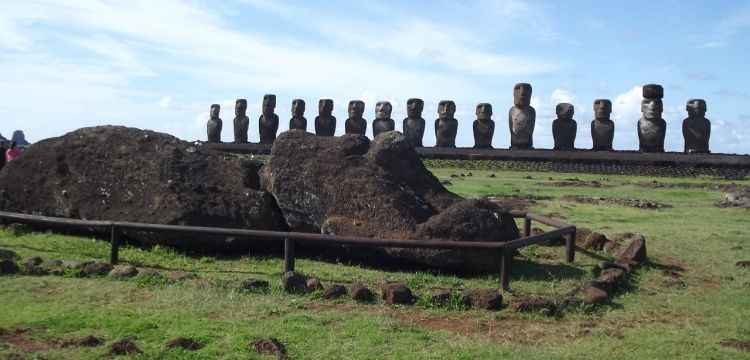
For centuries, the enigmatic monuments of Rapa Nui (Easter Island)—most famously the towering moai statues—have fascinated researchers and visitors alike. The island’s remote location, over 2,000 miles from the nearest inhabited land, has long fueled the assumption that its society developed in complete isolation after initial settlement. However, a groundbreaking study published in Antiquity now challenges this view, revealing that Rapa Nui was far more connected to the wider Polynesian world than previously believed.
Reevaluating Polynesian Ritual Networks
The research, led by Professors Paul Wallin and Helene Martinsson-Wallin of Uppsala University, analyzed archaeological data and radiocarbon dating from settlements, ritual spaces, and monuments across East Polynesia. Their findings suggest that, rather than developing in isolation, Rapa Nui and other Polynesian islands maintained interaction networks that facilitated the exchange of cultural and ritual practices long after initial colonization.
Polynesia’s settlement is widely accepted to have followed a west-to-east expansion, beginning in Tonga and Samoa before reaching distant islands like Hawai’i, Rapa Nui, and Aotearoa (New Zealand). However, the new study argues that the subsequent development of ritual practices and monumental architecture was far more dynamic, with influences moving both westward and eastward across the Pacific.
Three Phases of Ritual Development
The researchers identified three distinct phases in the evolution of Polynesian ritual spaces:
Initial Expansion (1000–1300 A.D.)
During this period, ritual activity was marked by actions such as burials and feasting, often signified by simple stone uprights. These practices spread as Polynesians migrated eastward, but crucially, the study suggests that interaction networks kept newly settled islands in contact with their homelands.
Materialization of Ritual Spaces (1300–1600 A.D.)
The second phase saw the emergence of more formalized ritual structures, particularly the marae—rectangular ceremonial clearings that sometimes included stone platforms (ahu). Intriguingly, radiocarbon dating indicates that the earliest complex marae structures appeared on Rapa Nui before spreading westward to central East Polynesia, contradicting the assumption that cultural innovations always moved from west to east.
“The complex, unified ritual spaces show earlier dates in the east,” explains Professor Wallin. This suggests that Rapa Nui was not only receiving influences but also exporting its own innovations back into Polynesian exchange networks. Genetic studies further support this, indicating contact between Rapa Nui and central Polynesia as late as the 14th century.
Monumentalism and Social Hierarchies (Post-1600 A.D.)
The final phase was characterized by increasing social stratification and the construction of massive stone monuments, such as the moai of Rapa Nui and the grand ahu structures of Tahiti and Hawai’i. As island societies developed internal hierarchies, their ritual sites became more elaborate, reflecting local power dynamics rather than broader regional exchanges.
Implications for Polynesian History
The study’s most significant revelation is that Rapa Nui was not the isolated outlier it was long believed to be. Instead, it played an active role in Polynesian cultural exchange, influencing ritual developments in other islands even as it absorbed outside ideas.
“This paper challenges commonly accepted ideas about the movement and development of ritual temple sites in East Polynesia,” says Wallin. “Initially, ritual ideas spread from west to east. Later, more elaborate temple structures developed on Easter Island, which then influenced other parts of East Polynesia in an east-to-west movement.”
A More Connected Polynesia
The findings align with growing evidence that Polynesian voyagers maintained extensive maritime networks, enabling the transfer of goods, ideas, and even people across vast distances. The notion that Rapa Nui was completely cut off after its initial settlement now appears outdated.
As Phys.org notes, the striking similarities in monuments and ritual practices across Polynesia make it difficult to believe these societies developed entirely independently. The new study provides a compelling framework for understanding how these connections functioned, reshaping our perception of one of the world’s most remote civilizations.
While the initial peopling of Polynesia undeniably followed a west-to-east trajectory, the cultural evolution of its islands was far more complex. Rapa Nui’s monumental architecture and ritual practices were not the products of isolation but of a dynamic, interconnected Polynesian world. This research not only rewrites aspects of Rapa Nui’s history but also highlights the resilience and adaptability of ancient seafaring societies in maintaining cultural ties across the Pacific.
For now, the moai stand not only as silent sentinels of Rapa Nui’s past but also as symbols of a much broader story—one of exchange, innovation, and enduring connections across the world’s largest ocean.

 Sadabad Sarayı’da ABD-İsrail Saldırıları İle Hasar Gördü: Kültürel Miras Tehlikede
  Anadolu’nun Kapısı Ani, Kültür Turizminin Yeni Merkezi
  Kolezyum’un Güney Koridorları Restorasyon Sonrası Yeniden Ziyarete Açıldı
  Sillyon Antik Kenti’nde Osmanlı Dönemine Ait Köy Meydanı Ortaya Çıkarıldı